How to Evaluate HOA and Condo Association Financial Health in SWFL Before You Buy or List
Buying or selling a condo or HOA-governed home in Naples, Bonita Springs, Fort Myers, or Cape Coral isn’t just about the unit or the view—it’s also about the community’s balance sheet. In Southwest Florida, association finances have always mattered, but they matter even more now because buyers have more choices, days on market have stretched in many areas, and post-storm maintenance planning has become a front-and-center cost.
Market snapshots in the region reinforce why association due diligence can make or break a deal: Naples pricing remains high (recent reports show median sale prices well above many surrounding markets), while parts of Lee County have seen price moderation and higher inventory—Cape Coral, for example, has been described as “not very competitive” with elevated days on market. In a slower or more selective environment, financially strong communities stand out, and financially strained ones tend to invite tougher negotiations, longer timelines, and appraisal/financing friction.
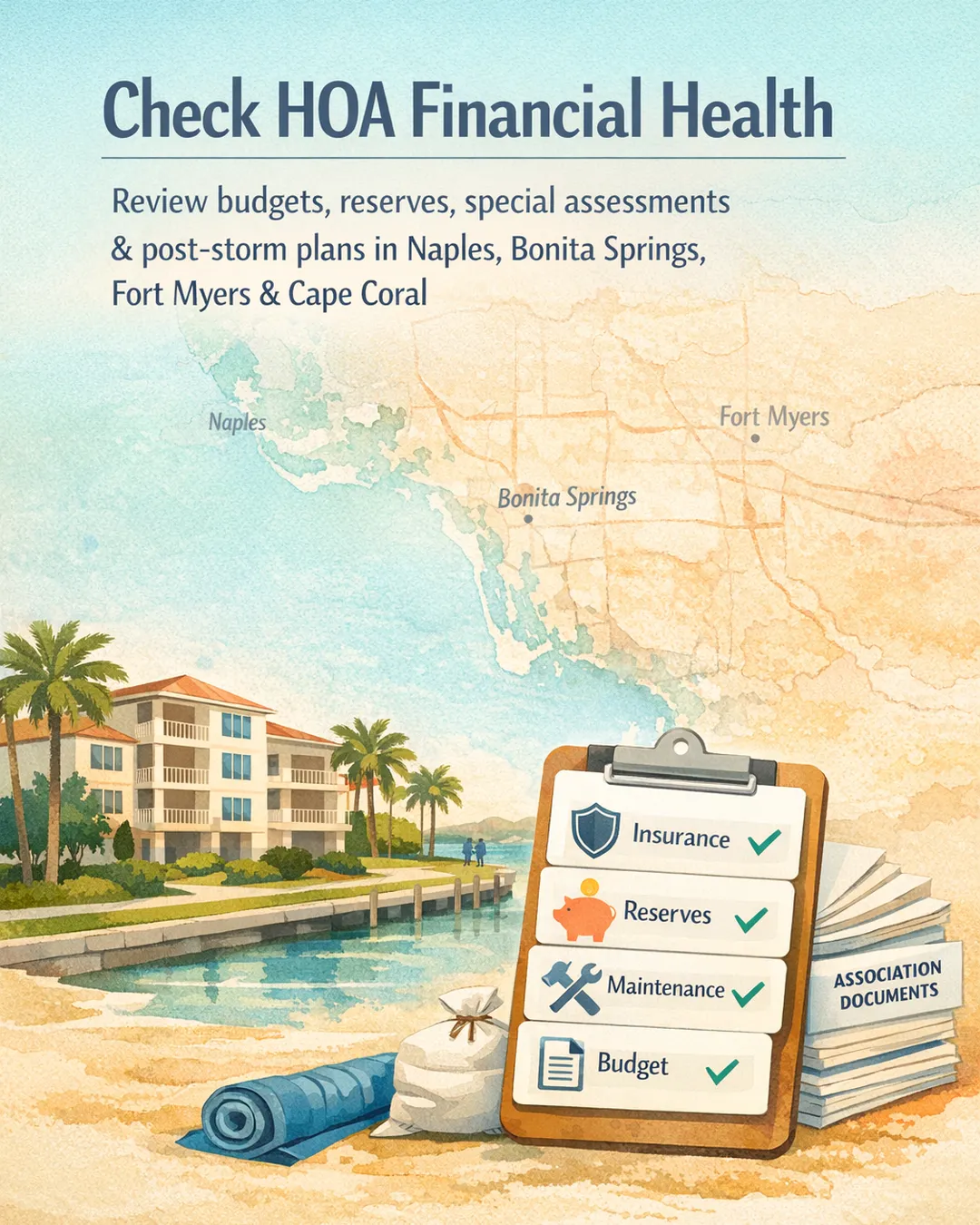
Below is a practical, SWFL-specific way to evaluate HOA and condo association financial health—budgets, reserves, special assessments, and post-storm plans—before you buy or list.
Why association finances are a deal-maker in SWFL right now
When inventory is higher and buyers have leverage (a theme seen in parts of Fort Myers and Cape Coral), they scrutinize monthly fees, upcoming projects, insurance costs, and the risk of special assessments. Even in premium markets like Naples, buyers paying top dollar want confidence that the association is well-run and prepared for Florida realities: wind, water, aging roofs, rising insurance premiums, and the cost of keeping amenities and common elements in top condition.
For sellers, association strength directly affects marketability. A clean financial story—transparent budget, healthy reserves, a clear maintenance plan—reduces objections, supports pricing, and helps buyers feel comfortable moving forward.
Start with the budget: what it reveals (and what it hides)
The annual budget is your first “x-ray.” Don’t just look at the monthly dues—look at what those dues are buying and whether the math is sustainable.
What to check in the operating budget
- Insurance line items (property, wind, flood where applicable, liability): In SWFL, insurance is often the biggest swing factor. Large year-over-year jumps without a strategy (higher deductibles, layered coverage, mitigation projects) can signal ongoing volatility. - Utilities and building systems: Water/sewer, irrigation, elevator contracts, fire systems, gate maintenance—these can climb quickly in older communities. - Landscaping and pool costs: Common amenities are a lifestyle draw in Naples and Bonita Springs, but they also create recurring obligations that may rise with labor and materials. - Management and legal: Higher legal spend isn’t automatically bad—sometimes it reflects active collections or contract enforcement—but it’s worth understanding the “why.”
Red flags in the budget
- Artificially low dues: If fees look “too good for the area,” it can mean underfunding or deferred maintenance. In SWFL, deferred maintenance often becomes expensive maintenance after a storm. - Reliance on one-time income: Large transfers, “miscellaneous” income, or unusually high late fees/collection income can mask structural issues. - High delinquency rates: If many owners aren’t paying, the community may struggle to maintain services—often a precursor to special assessments or service cuts.
Reserves: the difference between stability and surprise
Reserves are savings set aside for predictable, big-ticket replacements. In condos, this typically includes roofs, painting, paving, elevators, pool resurfacing, seawalls, and more. In HOA communities, reserve items vary but often include roads, drainage, gates, clubhouse facilities, and sometimes roofs if the HOA maintains them.
What buyers should request
- Reserve study (if available): A professional reserve study projects future replacement costs and recommended contributions. - Current reserve schedule: Shows what is being reserved for and how much is allocated. - Reserve funding level: Not just the reserve balance—ask whether the association is funding reserves in line with recommendations.
What “healthy reserves” looks like in practice
There’s no single perfect number, but a financially healthy association generally has: - A clear reserve plan tied to actual components (not vague categories). - Regular contributions (not sporadic “catch-up” years). - A history of completing projects without constant emergency assessments.
Common reserve pitfalls in SWFL
- Roof and envelope underfunding: Roofs, waterproofing, and exterior maintenance are especially critical in a wind-and-rain climate. - Seawall and drainage surprises: Waterfront communities in Naples, Bonita Springs, Fort Myers, and Cape Coral may face major seawall and canal-edge expenses. If reserves ignore these realities, owners may pay later.
Special assessments: not always bad, but always important
A special assessment is a one-time (or short-term) charge to owners—often used for major repairs, storm recovery gaps, or reserve shortfalls.
How to evaluate special assessment risk
Ask for: - A history of assessments for the last 5–10 years - Any approved or proposed assessments - Meeting minutes discussing upcoming projects - Engineering reports, roof inspections, or milestone-related inspections if applicable
How to interpret what you find
- One-time assessment for a well-scoped capital project can be a sign of proactive maintenance—especially if the board is executing a clear plan. - Repeated assessments (or ongoing “emergency” assessments) can indicate chronic underfunding, poor planning, or escalating insurance and repair costs the budget can’t absorb. - Assessments after storms are common in Florida, but the key question is whether the association had a plan, sufficient reserves, and appropriate insurance—and how quickly the community returned to normal operations.
Post-storm maintenance plans: the SWFL litmus test
Storm readiness isn’t just about shutters; it’s about the association’s operational playbook and financial capacity.
What a solid post-storm plan includes
- Vendor relationships in writing: Pre-negotiated contracts for roofing, water remediation, elevator service, landscaping cleanup, generator support, and security. - Clear responsibility map: Who handles what (board, management, building engineer, vendors). - Insurance claim process and documentation standards: How the association documents damage, communicates with owners, and handles deductibles. - Reserve strategy for deductibles and gaps: Many policies have sizable wind deductibles. Communities that plan for this reduce the chance of sudden owner bills.
Questions to ask (buyers) or prepare to answer (sellers)
- What major repairs were completed since the last major storm event? - Were there insurance claim disputes or litigation? - How long did it take to restore elevators, pool systems, gates, or landscaping? - Were owners hit with large unexpected charges—and if so, why?
Practical guidance for buyers: your due diligence checklist
Before you commit, ask your agent to help you obtain and review: - Current year budget and prior year actuals - Latest financial statements (balance sheet, income statement) - Reserve schedule and reserve study (if available) - Insurance summary (coverages, deductibles, claim history if disclosed) - Last 12 months of meeting minutes (board and membership, if available) - Disclosure of any pending special assessments or major projects - Rules affecting rentals, renovations, and storm protections (these can affect value and insurability)
Also consider your financing path. Some lenders scrutinize condo financial health, reserves, insurance, and delinquency rates. A weak association can limit loan options, shrink your buyer pool later, or force price concessions.
Practical guidance for sellers: how to position your community with confidence
If you’re listing in a market where buyers have options—common in higher-inventory areas like Cape Coral or in more price-sensitive segments of Fort Myers—association readiness can be a competitive advantage.
What helps most: - Be proactive with documents: Provide budget, insurance summary, and any reserve study early when possible. - Get ahead of “fee shock”: If dues increased, explain why (insurance renewal, completed improvements, reserve catch-up). - Show the plan: If the community has a post-storm protocol and recent capital improvements, highlight them. Buyers don’t just want “low fees”; they want predictability.
The bottom line for SWFL
In Naples, Bonita Springs, Fort Myers, and Cape Coral, association financial health is not a minor detail—it’s part of the property. A well-funded, well-insured, well-planned association supports resale value and smoother transactions. A poorly funded one can create sudden costs, tougher financing, and longer days on market—especially in today’s more selective buying environment.
If you’re buying or listing in SWFL and want help interpreting HOA/condo financials, reserves, or assessment risk in the context of your specific community and price point, contact Soline Sells SWFL for local guidance and a clear plan for your next move.
